If you’ve read a blog or watched a video telling you to get the JR Rail Pass, check the date. That advice was probably from before October 2023. Because after that, the price of the JR Pass jumped by about 70%, and now, for most people doing short- to mid-range trips, it’s just not worth it. For us, travelling as a family in the Kansai region – places like Osaka, Kyoto, Nara, and Kobe we found the ICOCA card not only cheaper but a lot more convenient.
Feeling confused by all the transport options, you’re not alone. We’ve broken down everything you need to know about using an ICOCA card below, but if you’re also trying to figure out whether to fly or take the bullet train between cities, this post comparing the Shinkansen with domestic flights might help too
Why ICOCA Makes More Sense Now
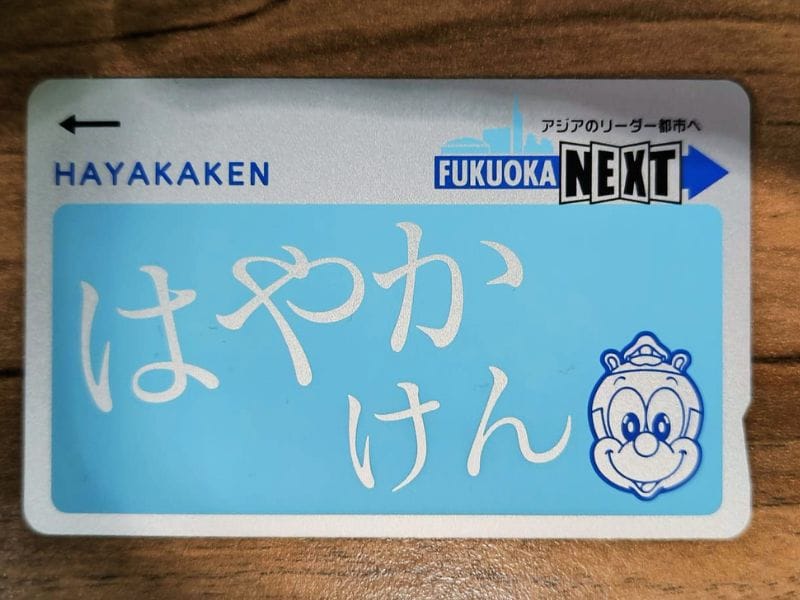
ICOCA is one of Japan’s regional IC cards. It’s rechargeable, tap-on-tap-off, and works across all sorts of transport, trains, metros, buses, and even in shops and vending machines. For us, travelling as a family, it was far less hassle than the old-school paper tickets.
Point-to-point travel with an ICOCA card is now significantly cheaper than splashing out on a national JR Pass, unless you’re doing huge distances every other day. And even then, it depends.
We used it for pretty much everything during our time in Osaka, Kyoto, and surrounding areas. For a real-world example of how we built our entire Osaka trip around this setup, you can check out our 3-day Osaka itinerary – spoiler: it’s totally doable on a budget, with kids, and a single card each.
How to Get an ICOCA Card (Without Losing Your Mind)
They can be dispensed from machines at most train stations but only the red machines have this function, and they’re cash only, so come prepared. The machines do have an English option, but that’s your lot, its the only other language option. It’s Japanese or English. Full stop. I
A standard ICOCA card costs ¥2,000 that’s ¥500 deposit and ¥1,500 loaded credit.
There’s a child version (called a kodomo ICOCA) but it’s not available everywhere. You’ll need to visit a staffed JR office and show ID to prove your child’s age (6 to 11). These aren’t at every station, so do a quick Google before heading out.
Under‑6s ride free, so no card needed for them or, in our case, if your child is seven and can just about pass for it… well, let’s just say we weren’t stopped. Don’t judge. This is a budget family travel blog, not a place for morals.
Beyond Trains: Where You Can Use ICOCA
You can use the ICOCA card in numerous other places:
- JR West lines
- Osaka, Kyoto, and Kobe metros
- Private railways
- Local buses
- Convenience stores
- Vending machines
- Luggage lockers
- Restaurants
What surprised us was how often it worked where our contactless debit card didn’t. Loads of places, even tiny corner shops and vending machines wouldn’t take our UK card, but ICOCA worked instantly. It’s not something we’d seen mentioned anywhere, but it made a huge difference.
It can be topped up outside of the train stations as well, with top up at 7-Eleven being most easily accessible.
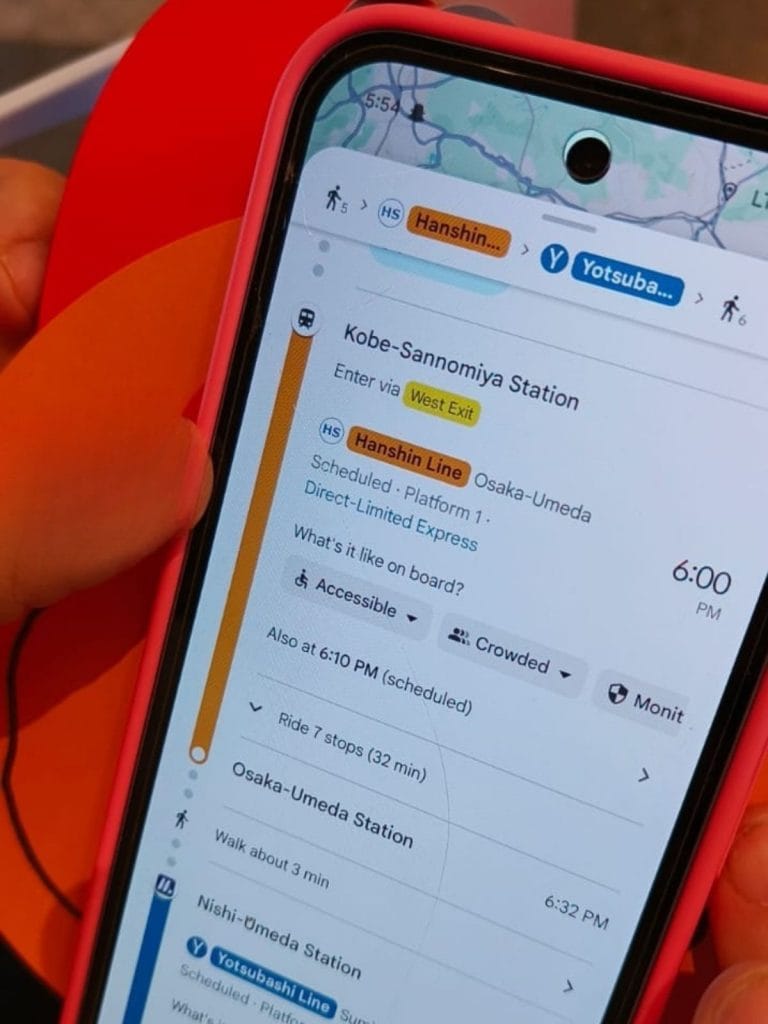
Google Maps also deserves a shoutout here. It’ll show you the exact fare before you even leave your hotel, which helps massively when you’re trying to guess how much to load on each card.
Same goes for places like Universal Studios Japan. We used ICOCA to get there too, and it all worked seamlessly. If you want the full breakdown on what to expect as a family, our review of Universal is brutally honest worth a look before you book.
What Happens If Your Balance Runs Out?
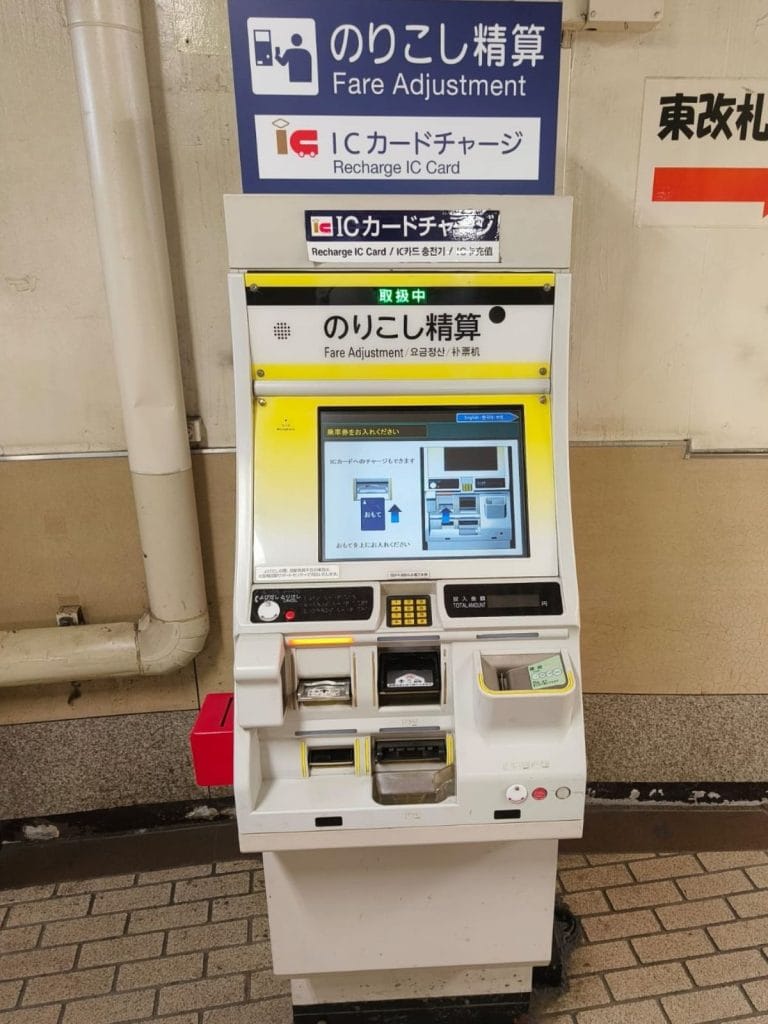
If your balance is too low, the gate flashes red and won’t let you through. You’ll get a moment of public shame. Then you head over to a fare-adjustment machine, tap your card, and it’ll tell you how much you owe. Pay the difference in cash, and you’re good.
Now, just a little story here: if you arrive at a small countryside station where there are no gates, and you’re tempted to think, “Maybe I can skip scanning out and just scan back in later at my origin station,” don’t bother. You’ll get stopped at the gate, end up trying to explain the logic in a language you don’t speak charged and still get charged for the full journey. Don’t ask me how I know, but i do.
One Limitation You Should Know
While you can use ICOCA cards across Japan, even in Tokyo or Sapporo. You can’t cross between IC card regions on a single ride. So if you’re going from Osaka to Fukuoka, you’ll need to tap out in one region and tap in again in the other. Otherwise, the gates won’t know how to charge you.
If you’re planning longer journeys, it’s worth reading our Shinkansen vs Flying post, especially with kids. There were a few unexpected wins on both sides.
Luggage Panic? Don’t Worry
Everyone online says not to bring large luggage on the trains, that it’s “not the Japanese way,” and you’ll be judged into the ground. From you tube vlogs to other blogs posts and yes, generally they are correct but that’s not the reality? There’s still plenty of locals with luggage on the trains
We brought two kids, four suitcases, and three pieces of hand luggage from Juso all the way to the airport on the train and no one even blinked. We weren’t packed into rush hour, so it was fine. There is luggage services that will drop to your final destination but they’re not exactly budget friendly and in my opinion only worth it for long journeys.
Same goes for places like Universal Studios Japan. We used ICOCA to get there too, and it all worked seamlessly. If you want the full breakdown on what to expect as a family, our review of Universal is brutally honest, worth a look before you book.
Final Thoughts: Is ICOCA Worth It?
In our opinion? Absolutely.
It’s simple, it works everywhere we needed it to, and it saved us time, money, and the stress of navigating ticket machines at every stop with two kids in tow.
You don’t need to pre-book it, you don’t need to activate anything, and you won’t be standing in a queue wondering if you’re in the wrong line. You just grab one, top it up, and go.
If you’re sticking to Kansai – Osaka, Kyoto, Kobe, Nara – or even heading as far as Hiroshima or Okayama, ICOCA is the easiest and most flexible option. Combine it with Google Maps and a few snacks in your bag, and you’re already two steps ahead of most tourists.